
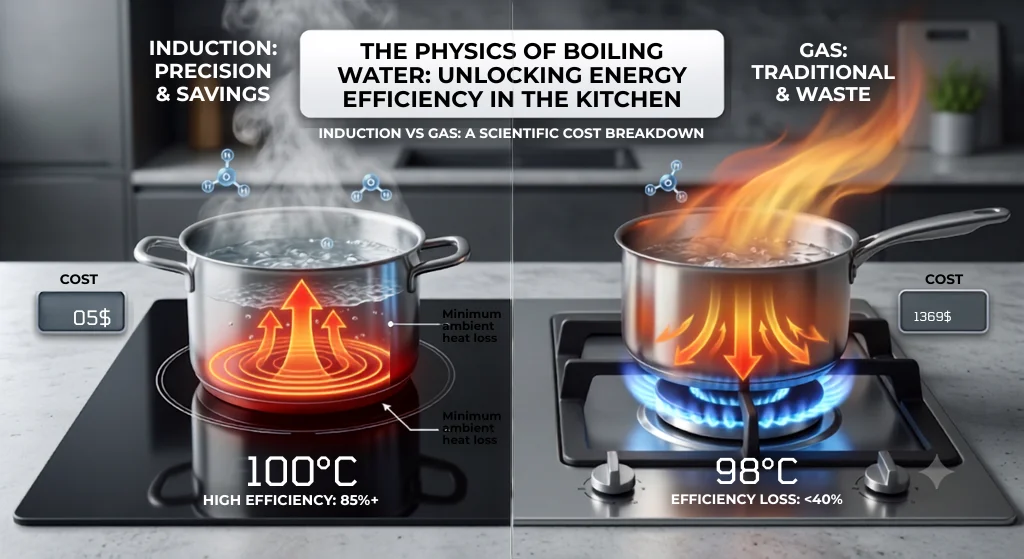
Still relying on a roaring blue gas flame to boil 5 gallons of wort or heat a giant stockpot, assuming gas is always cheaper? You’re likely burning money straight into thin air.
When heating large volumes of water, thermal transfer isn’t just about raw power—it’s about microscopic molecular kinetic energy distribution and boundary layer dynamics. Let’s break down the actual physics of heat transfer, calculate the precise cost per kilocalorie for gas versus induction, and help you build the ultimate high-efficiency kitchen setup.
The Physics Behind It: Equipartition of Energy and Boundary Losses
Why does gas waste so much energy? It comes down to molecular kinetic energy distribution and how heat moves at the boundary layer.
- Energy Equipartition at the Molecular Level: According to the equipartition theorem, thermal energy supplied to water molecules ($H_2O$) distributes evenly across their degrees of freedom—translational, rotational, and vibrational ($E = \frac{1}{2} k_B T$ per degree of freedom). To raise 1 liter of water by 1°C, you strictly need 1 kcal (4.184 kJ) of kinetic energy transferred to those molecules, regardless of the heat source.
- The Gas Flame Thermal Leak: A gas burner relies on ambient convection and radiation. A massive portion of the kinetic energy generated by combusting methane ($CH_4$) escapes into the surrounding air, heating your kitchen rather than the water molecules inside the pot. Gas stoves operate at a dismal 35%–40% thermal efficiency.
- Induction Electromagnetic Coupling: Induction skips ambient air entirely. An alternating magnetic field induces eddy currents directly within the ferromagnetic base of your pot ($P = I^2 R$). The pot itself becomes the heating element. With minimal radiative loss, induction achieves an astounding 85%–90% thermal efficiency.
Water Boiling Cost Calculator
Energy & Cost Simulation for Home Brewing & Cooking
Step-by-Step Troubleshooting: Optimizing Your Boiling Rig
Step 1: Calculate Your Real Thermal Requirement
Before spending a dime on fuel or electricity, know your baseline energy requirement using the standard specific heat capacity formula:
$$Q = m \cdot c \cdot \Delta T$$
Example: Heating 20 Liters (5.3 Gal) of brewing water from 20°C to 100°C ($\Delta T = 80^\circ\text{C}$):
- $Q = 20\text{ kg} \times 1\text{ kcal/kg}^\circ\text{C} \times 80^\circ\text{C} = \mathbf{1,600\text{ kcal}}$ (or $\approx 1.86\text{ kWh}$)
Step 2: Compare Energy Costs by Thermal Efficiency
Here is how the real-world performance breaks down when factoring in losses:
| Parameter / Metric | Gas Stove (LNG/LPG) | Induction Cooktop |
| Typical Thermal Efficiency | ~35% – 40% | ~85% – 90% |
| Input Energy Needed for 1,600 kcal | ~4,210 kcal | ~1,820 kcal (~2.12 kWh) |
| Heat Lost to Ambient Air | ~2,610 kcal (Wasted) | ~220 kcal (Minimal) |
| Relative Boiling Time (20L) | Slow (Convection losses) | Fast (Direct vessel heating) |
| Cost Efficiency Impact | High fuel waste offsets lower gas unit rates | Higher efficiency dramatically cuts kWh usage |
Step 3: Match Vessel Geometry and Material
- Pot Material Matters: Induction requires a high-magnetic-permeability vessel (430-grade stainless steel or cast iron). Standard aluminum pots will not couple with the induction coil.
- Maximize Surface Area: Match the burner/induction coil size precisely to the bottom of your pot. An overhang on a gas stove allows hot exhaust gases to bypass the pot entirely.
Key Takeaway for Your Kitchen Setup
If you regularly heat large volumes of water for brewing, canning, or high-volume cooking, transitioning to a high-wattage induction system (3,000W+) delivers immediate efficiency gains. You lose less thermal energy to your room, boil up to twice as fast, and drastically reduce overall energy waste per batch.
To see how thermodynamics controls other aspects of your daily life, visit the [Gear & Logic: Applied Physics and Mathematics] archive, or run cost simulations with our [Interactive Tools: Live Science & Engineering Calculators].