
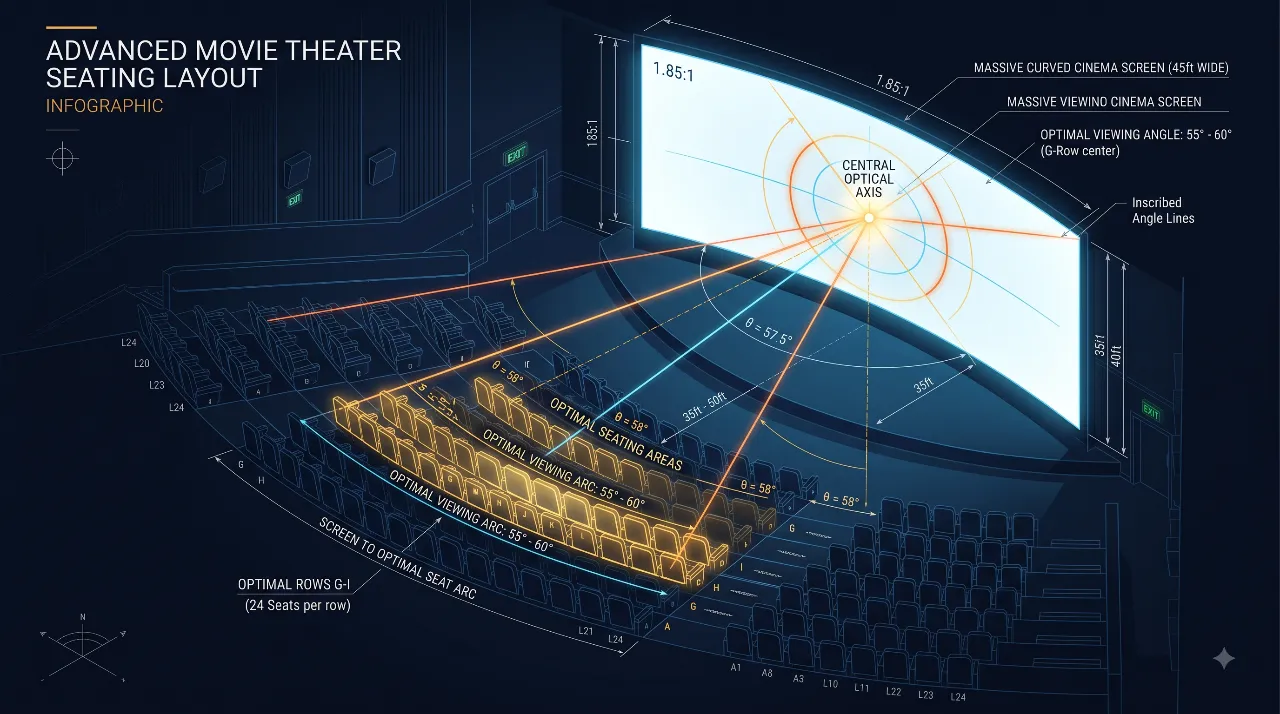
Never compromise your movie experience with a neck strain or an awkward view again. You walk into a crowded theater, eagerly anticipating a blockbuster, only to find yourself second-guessing your seat selection. Sit too close, and you are constantly panning your head like a tennis referee; sit too far back, and the immersive cinematic magic shrinks to the size of a home television.
Finding the absolute best seat in the house is not a matter of luck—it is a spatial optimization problem that simple geometry solves in seconds.
The Geometry Behind It: The Inscribed Angle Theorem at the Movies
The secret to ideal theater seating relies on the Inscribed Angle Theorem. In classical geometry, this theorem states that an angle inscribed in a circle is determined by the arc it subtends, and any angle subtending the same arc from any point on the circle’s circumference remains identical.
[ SCREEN ]
       /        \
      /  Arc AB  \
     /            \
   (Seat 1)     (Seat 2)   <-- Same viewing angle along the circular arc
When applied to a movie theater:
- The Screen as the Arc: The width of the movie screen acts as the fixed arc $AB$.
- The Viewing Angle: The angle formed from your eyes to the left and right edges of the screen is the inscribed angle.
- The Iso-Angle Curve: By drawing an imaginary circle that passes through both edges of the screen and your seat, every single seat sitting along that specific circular arc experiences the exact same field-of-view angle.
This geometric property means you do not need to sit dead-center in a middle row to get the best visual field. As long as you stay on the circular arc defined by the optimal viewing angle, your eyes absorb the same portion of the screen without added distortion.
According to the Society of Motion Picture and Television Engineers (SMPTE), a viewing angle of 30° to 40° provides optimal immersion while keeping visual fatigue to a minimum.
| Distance Ratio (Distance / Screen Width) | Viewing Angle (Degrees) | Visual Comfort Level | Recommended Experience |
| < 0.8x | > 60° | Extreme Neck Strain / Motion Sickness | Front Rows (Avoid) |
| 0.8x – 1.0x | 50° – 60° | High Intensity / Edge Distortion | IMAX Enthusiasts / Action Movies |
| 1.2x – 1.5x | 35° – 45° | Golden Zone (Optimal Immersion) | Standard Blockbusters / Story-Driven |
| 1.8x – 2.2x | 25° – 30° | Relaxed / Small Screen Perception | Casual Viewing / Subtitled Films |
| > 2.5x | < 20° | Low Engagement / Distracting Environment | Far Back Rows (Avoid) |
Cinema Viewing Angle & Best Seat Calculator
Calculate optimal field of view based on THX & SMPTE cinema standards
Optimal cinematic immersion! Exceeds the THX 36° reference standard for genuine cinematic field of view without inducing neck strain.
Step-by-Step Guide to Spotting the Golden Seat Line
Step 1: Calculate the Screen-to-Distance Ratio
Before booking, check the auditorium's specifications or look at the seating chart layout. Identify the row where the distance to the screen is roughly 1.2 to 1.5 times the width of the screen. This distance consistently yields a comfortable 35° to 40° viewing angle across standard aspect ratios (1.85:1 and 2.39:1).
Step 2: Leverage the Arc—Move Off-Center Safely
If the exact middle seats of the golden row are fully booked, do not default to moving further back. Use the Inscribed Angle principle: move slightly to the side along the curved row. Because modern theater rows are often curved along a circular arc centered toward the screen, sitting a few seats off-center on a curved row preserves a near-identical viewing angle compared to the center seat.
Step 3: Account for Vertical Tilt and Acoustics
Maintain a horizontal sightline where the top of the screen requires no more than a 15° vertical tilt of your head. Combining a 35° horizontal viewing angle with a flat-to-slight vertical orientation aligns your eyes directly within the acoustic sweet spot of the theater's surround-sound arrays.
Optimizing Your Home Theater and Viewing Environment
Understanding spatial geometry transforms how you consume visual content beyond commercial cinemas. When configuring a home theater, living room display, or ultra-wide desktop monitor, use these same arc-based calculations instead of guessing distances. Position your primary seating to achieve a 30° to 40° field of view, elevate the display so the center rests at eye level, and engineer a balanced sightline that prioritizes long-term visual ergonomics alongside maximum immersion.
To explore more practical mathematical guides designed for makers and creators, visit our [Gear & Logic: Applied Physics and Mathematics] hub, or browse our suite of web simulators in [Interactive Tools: Live Science & Engineering Calculators].