
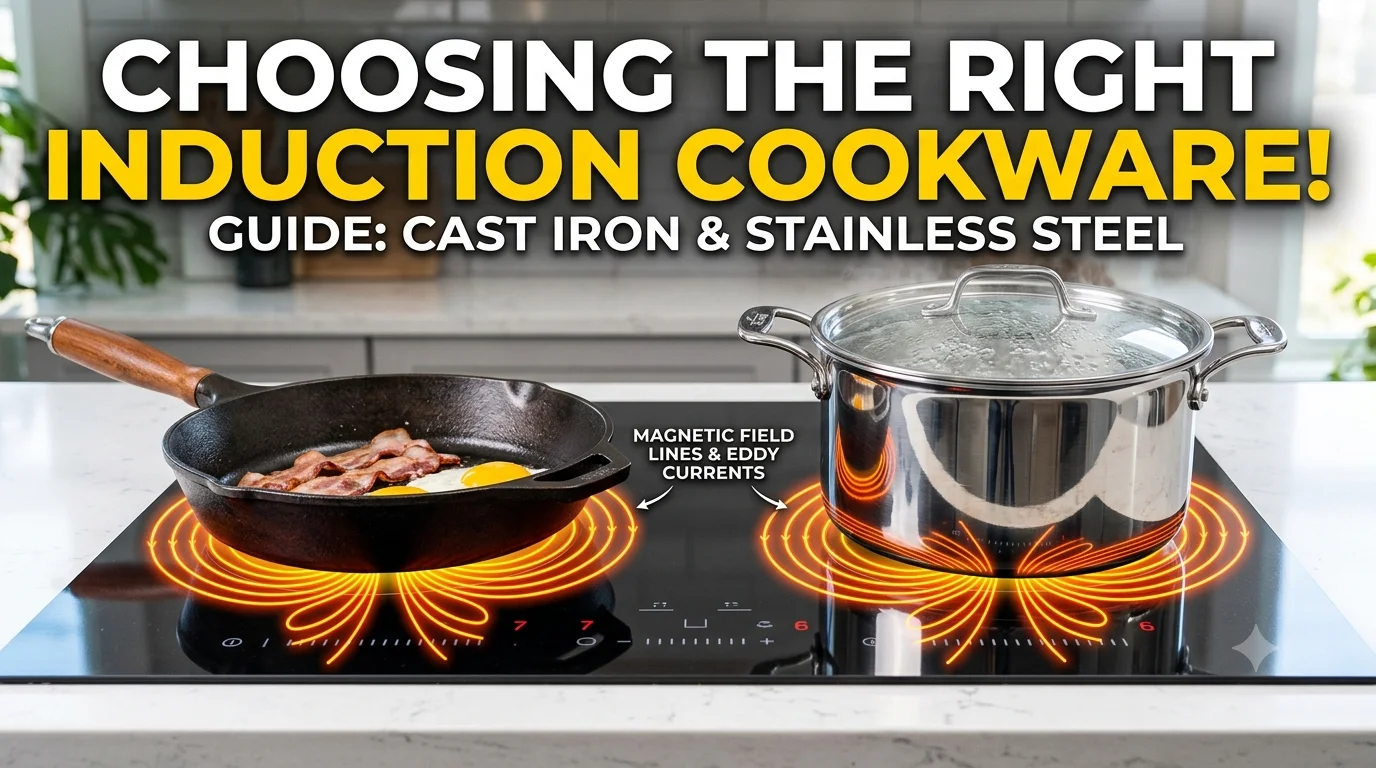
Is your high-end induction cooktop humming loudly, heating unevenly, or taking forever to boil water despite using expensive cookware? You are not alone. Most home chefs assume any pan with a “magnet-stick” bottom guarantees maximum efficiency. In reality, poor electromagnetic coupling wastes energy, strains your cooktop’s internal coils, and turns your cooking process into a frustrating guessing game.
Let’s dive into the core physical principles governing your cooktop and learn how to select pans that maximize thermal transfer.
The Physics Behind It: How Lenz’s Law Dictates Your Kitchen Efficiency
Induction cooking does not generate thermal energy directly on the cooktop surface. Instead, an alternating current runs through copper coils beneath the glass top, generating a rapidly fluctuating magnetic field.
[ Copper Coil (Alternating Current) ]
                 │
                 ▼
    [ Fluctuating Magnetic Field ]
                 │
                 ▼
[ Pan Base (Opposing Field via Lenz's Law) ]
                 │
                 ▼
   [ Eddy Currents & Resistive Heat ]
When you place a compatible pan on top, Lenz’s Law comes into play. Nature naturally opposes changes in magnetic flux: as the cooktop’s magnetic field switches direction thousands of times per second, the conductive base of your cookware generates its own opposing magnetic field.
This opposition triggers intense circulating electrical currents within the base metal—known as Eddy Currents. As these currents encounter electrical resistance in the pan’s material (Joule Heating), heat is generated directly inside the pan itself.
- High-Permeability Materials (e.g., Cast Iron, Ferritic Stainless): Confine and concentrate magnetic field lines inside the pan base, triggering dense eddy currents and high heat output.
- Non-Magnetic Materials (e.g., Copper, Pure Aluminum): Allow magnetic fields to pass through without sufficient resistance, resulting in zero induction response unless layered with a specialized magnetic plate.
Interactive Tool Placeholder
Induction Cookware Compatibility
Simulate electromagnetic heat transfer based on Faraday & Lenz’s Laws
Decoding Cookware Materials: Magnetic Response vs. Thermal Transfer
To get peak performance out of a 3-burner induction range, you need cookware with high magnetic permeability at the base and optimal thermal conductivity at the core.
| Cookware Material | Magnetic Pull Strength | Induction Heat Efficiency | Thermal Distribution | Best Use Case |
| Enameled / Cast Iron | Exceptional | Highest (90–95%) | High Retention / Slow | Slow Cooking, Searing |
| 430 Stainless Steel (Ferritic) | Strong | High (80–80%) | Moderate | Outer base layer of multi-ply pans |
| 304 Stainless Steel (Austenitic) | Weak to None | Poor / Incompatible | Moderate | Food-contact inner layer |
| Aluminum (Pure) | None | Incompatible (0%) | Excellent | Requires encapsulated steel disk |
| Copper | None | Incompatible (0%) | Superior | Requires encapsulated steel disk |
Step-by-Step Troubleshooting: The 3-Step Magnet Test & Selection Protocol
Step 1: Execute the 45-Degree Magnet Slide Test
Do not just stick a magnet to the bottom of the pan—test the magnetic resistance.
- Hold a neodymium magnet at the edge of the pan base and incline it to a 45-degree angle.
- If the magnet snaps instantly to the center and resists sliding, the ferrous content is high enough to handle intense eddy currents.
- If it slides off easily or barely sticks, the pan will draw excessive current from your cooktop, leading to heat loss and coil noise.
Step 2: Measure Base Flatness and Surface Area Coverage
Lenz’s law relies heavily on proximity. A magnetic field drops off exponentially with distance.
- Place a straightedge rule across the bottom of the pan.
- Any gap greater than 1mm disrupts flux line density. Warped pans create localized hot spots and trigger safety shut-offs on modern induction sensors.
- Ensure the pan’s magnetic base matches the burner ring diameter within a 10% tolerance to prevent magnetic leakage.
Step 3: Verify Multi-Ply Encapsulation Structure
Raw cast iron offers incredible magnetic response, but it can scratch delicate glass tops. For daily cooking, choose clad cookware engineered specifically for magnetic drive:
- Look for Tri-Ply or 5-Ply construction featuring an exterior layer of AISI 430 stainless steel (for maximum Lenz’s law response) sandwiching an interior core of pure aluminum or copper (for rapid heat diffusion).
- Avoid cheap “impact-bonded” disks that use thin metal plates, as thermal stress will cause them to delaminate over time.
Engineering Your Ultimate Kitchen Setup
Achieving precision temperature control and blistering heat times on an induction cooktop isn’t about buying the most expensive cookware—it’s about matching electromagnetic physics with proper metallurgy. Prioritize full-clad cookware with a thick 430-series stainless steel exterior or premium enameled cast iron. By pairing high-permeability metals with proper coil coverage, you minimize energy loss, preserve your appliance’s lifespan, and achieve master-level heat control.
For more deep dives into electromagnetism and kitchen physics, explore [Gear & Logic: Applied Physics and Mathematics], or test other cookware compatibility with calculators in [Interactive Tools: Live Science & Engineering Calculators].