
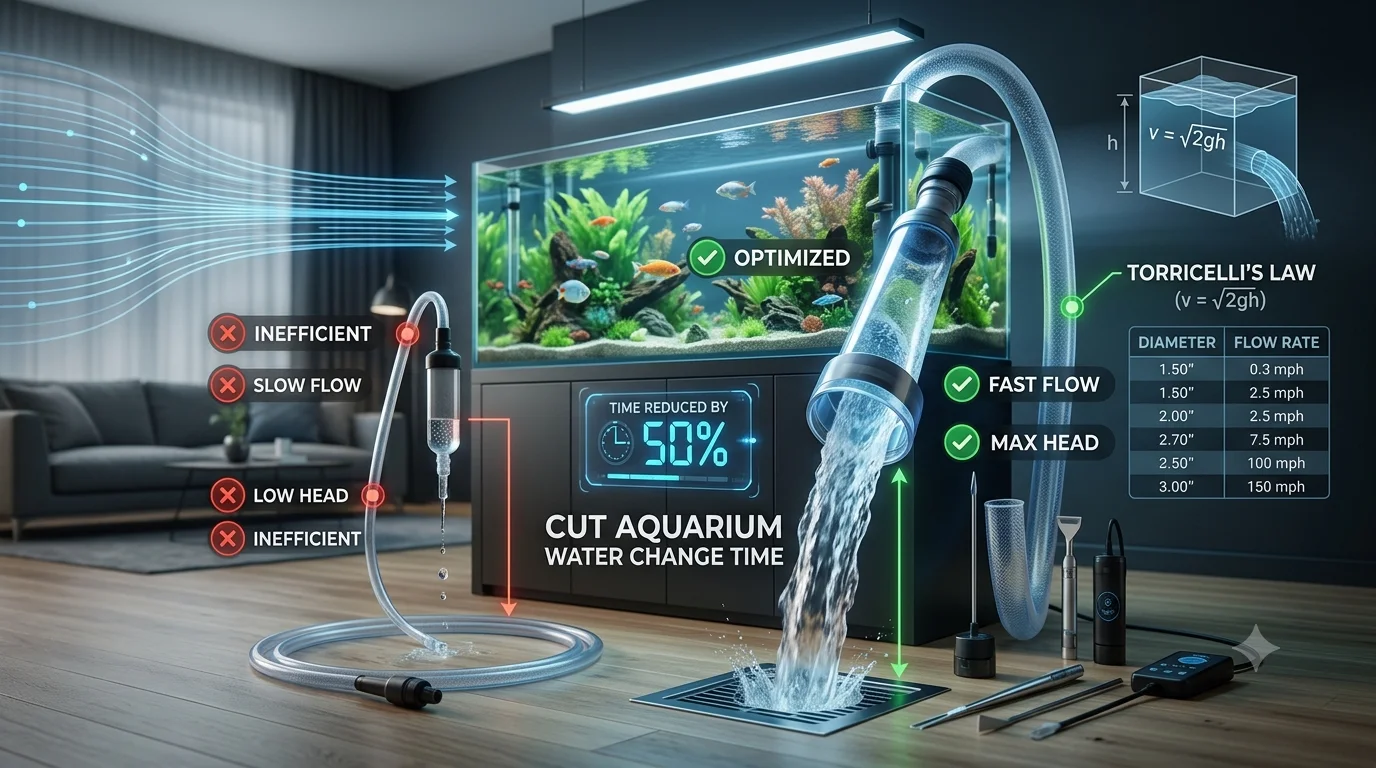
If you own a large aquarium, water change day probably feels like a slow, painful endurance test. You setup your siphon, start the flow, and then sit there watching the water trickle out at a agonizingly slow pace—especially during the last few inches.
Why does a siphon start with a roaring flow and finish with a pathetic drip? It isn’t just bad luck; it’s physics. By tweaking two simple variables in your drainage setup, you can cut your tank draining time in half without spending a dime on powered pumps.
The Physics Behind It: Torricelli’s Law and the Low-Water Trap
The secret behind siphon speed lies in a 17th-century fluid dynamics principle known as Torricelli’s Law. Simply put, the velocity ($v$) of water exiting a siphon tube depends entirely on gravity ($g$) and the vertical height difference—or hydraulic head ($h$)—between the tank’s water surface and the hose exit:
$$v = \sqrt{2gh}$$
Notice that fluid velocity is proportional to the square root of the height difference ($\sqrt{h}$), not a linear line.
[ Tank Water Level ]
        |
        |  <- Vertical Height Difference (h)
        v
[ Drain Exit Point ]  --> Water Velocity (v = √(2gh))
Here is why your water changes slow down to a crawl halfway through:
- Collapsing Hydraulic Head ($h$): As the tank water drains, the distance between the water surface and your drain container shrinks. Less height means less potential energy driving the flow.
- Non-Linear Drop: Because of the square root relationship, cutting your height difference by half doesn’t just reduce flow by a little—it dramatically slashes discharge velocity.
- Frictional Resistance (Poiseuille’s Law): Internal friction inside long, narrow hoses acts as fluid resistance. As velocity drops, friction becomes the dominant force stopping your flow.
Interactive Tool Placeholder
Siphon & Water Change Calculator
Torricelli’s Law Interactive Simulator
* Calculated using Torricelli’s Law ($v = \sqrt{2gh}$) with standard fluid friction compensation ($\sim C_d = 0.62$). Real-world speed may vary based on hose bends and debris filters.
Optimizing Flow Rate: Hose Diameter vs. Vertical Drop
To double your drainage speed, you must control both fluid velocity (height) and volume throughput (hose cross-sectional area). The table below illustrates how inner hose diameter (ID) and vertical head drop directly affect your drain rates.
| Hose Inner Diameter (ID) | Vertical Drop (h) | Estimated Flow Rate | 100-Gallon (380L) Drain Time |
| 1/2 inch (12 mm) | 1.0 meter | ~12 L/min | ~31 minutes |
| 1/2 inch (12 mm) | 2.0 meters | ~17 L/min | ~22 minutes |
| 3/4 inch (19 mm) | 1.0 meter | ~30 L/min | ~12 minutes |
| 3/4 inch (19 mm) | 2.0 meters | ~42 L/min | ~9 minutes |
Note: Estimates account for standard PVC hose friction coefficients.
Step-by-Step Troubleshooting: 3 Steps to Maximize Siphon Speed
Step 1: Maximize Your Hydraulic Head ($h$)
Place your discharge bucket or drain as low as physically possible. If you are draining into a bucket, do not place it on a stool—leave it flat on the floor. Draining directly into a basement drain or lower floor fully maximizes $h$, maintaining high velocity even when the tank level drops.
Step 2: Step Up Hose Inner Diameter
Swapping a standard 1/2-inch (12 mm) hose for a 3/4-inch (19 mm) hose doubles the cross-sectional area. Since volumetric flow rate ($Q$) equals velocity times area ($Q = A \times v$), this single upgrade slashes your drain time in half instantly.
Step 3: Eliminate Kinks and Sharp Bends
Every sharp turn or kink in your vinyl tubing creates local turbulence, introducing head loss. Use wide-sweep rigid elbows or smooth tubing guides where the hose hangs over the tank glass to maintain uninterrupted laminar flow.
Investing in the Right Water Change Equipment
Understanding the mechanics of water flow reveals that faster water changes aren’t about buying expensive electric pumps. They come down to smart tubing choices and maximizing gravity drop.
If you manage massive displays (over 100 gallons), premium high-bore siphon systems fitted with wide 3/4-inch anti-kink hoses and dedicated brass ball valves offer the absolute fastest gravity-fed drainage possible—giving you back hours of your weekend without electrical risk or noisy motors.
To understand the fluid dynamics governing other home systems, read more in [Gear & Logic: Applied Physics and Mathematics], or simulate your plumbing projects in [Interactive Tools: Live Science & Engineering Calculators].