
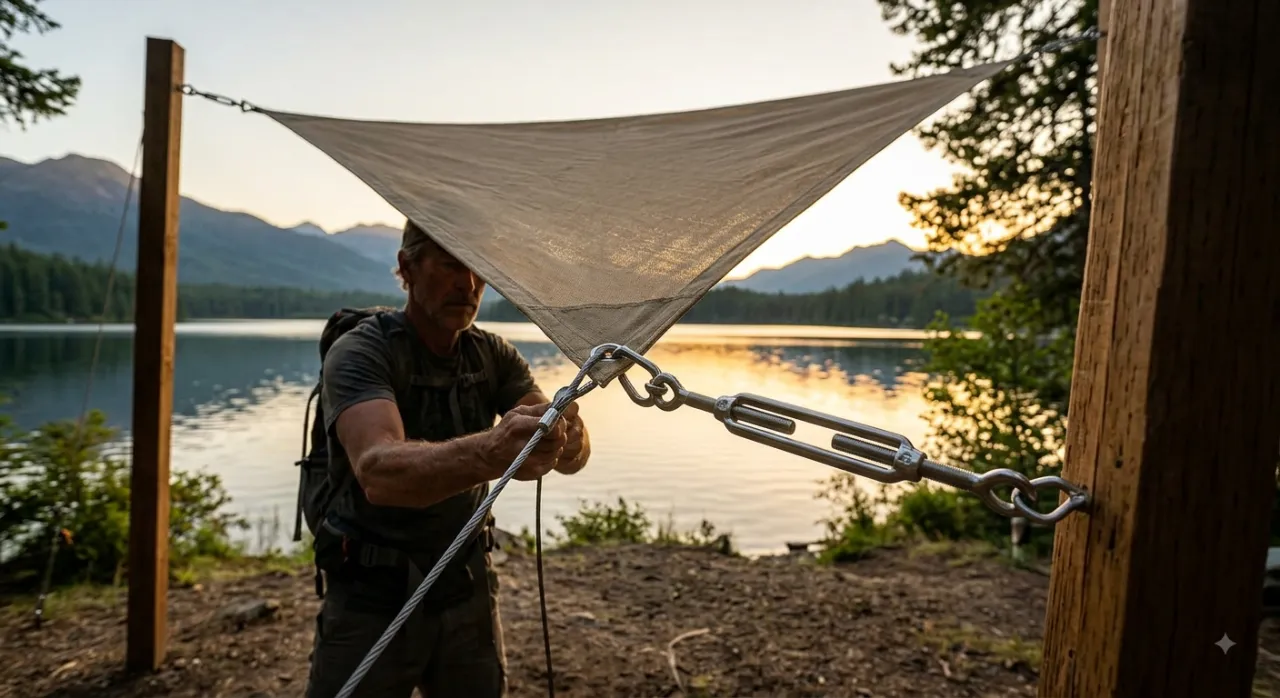
Every outdoor creator knows the frustration: you spend hours tensioning a triangular shade sail over your patio, only for the first moderate gust of wind to turn it into a violently flapping sail or, worse, rip an anchor bolt clean out of the wall. When a shade sail sags or pulls unevenly, it is not just bad hardware—it is unbalanced geometry. Without precise geometric locking, dynamic wind loads concentrate along a single edge, shearing turnbuckles and tearing fabric.
The Physics Behind It: Geometric Rigidity via Triangle Congruence
A fabric shade sail is a tension-only membrane. Unlike a rigid truss, fabric cannot resist compressive or bending forces; it requires static equilibrium across all anchor vectors. Triangle congruence theorems ($SSS$, $SAS$, $ASA$) define whether a three-point anchoring system forms a structurally locked, non-deforming plane under dynamic load.
Anchor A (High, 3.0m)
              /\
             /  \  Tension Line c
            /    \
Tension    /      \
Line b    /   Δ    \
         /  Canvas  \
        /____________\
Anchor B              Anchor C (Low, 2.2m)
(High, 3.0m)    Tension Line a
1. SSS Congruence (Side-Side-Side) & Isometric Tension Lock
When you measure and fix the three perimeter edge lengths ($a, b, c$) between your anchor points to match the exact engineered dimensions of the sail (factoring in 10% turnbuckle take-up), you enforce $SSS$ congruence. This eliminates shearing degrees of freedom:
- Failure Mode: If one anchor-to-anchor measurement deviates by even $5\%$, tension distributes unevenly, creating a slack boundary line that flaps under wind uplift.
- Math in Action: Fixing three distinct lengths locks the internal angles ($\alpha, \beta, \gamma$) via the Law of Cosines:$$\cos(\alpha) = \frac{b^2 + c^2 – a^2}{2bc}$$When the side lengths are statically fixed, no angle can distort under static wind shear.
2. SAS Congruence (Side-Angle-Side) & Corner Vector Alignment
The tension vector at any corner must bisect the interior angle of that corner. If you set two anchor cable lengths ($b, c$) and lock the angle ($\alpha$) between them:
- The opposing edge tension automatically stabilizes without lateral fabric roll.
- Off-axis mounting angles induce torsional moment, twisting the D-rings and causing uneven wear.
3. Hyperbolic Paraboloiding: Breaking Planar Resonance
A completely flat triangle resonates at low wind frequencies. Creating height differentials between anchor points forms a 3D hyperbolic paraboloid tension profile. Congruent edge ratios ensure that tension distributes equally across the diagonal stress axes.
| Configuration Method | Congruence Basis | Primary Risk | Wind Resistance Rating | Tension Uniformity |
| Fixed Cable Measure | SSS Rule | Anchor post deflection if unbraced | High (Up to 45 mph) | 95% Balanced |
| Corner-Angle Guided | SAS Rule | Dynamic corner flutter on raw edge | Moderate (30 mph) | 80% Balanced |
| Sightline Guesswork | None (Variable) | Catastrophic anchor pullout / Tear | Critical Failure (< 20 mph) | Uncontrolled Shear |
DIY Backyard Shade Sail Setup
Tension & Triangle Congruence Simulator
Step-by-Step Troubleshooting: Geometric Tensioning Protocol
Follow this precision tuning guide to lock in dynamic stability on your shade sail setup:
- Calculate the $10\%$ Turnbuckle Allowance per Vector: Measure the distance between your mounting eye-bolts ($D_{total}$). Select a shade sail whose corresponding edge length ($L_{sail}$) satisfies:$$L_{sail} \le D_{total} – 2 \times (\text{Turnbuckle Extended Length})$$Leave at least 300 mm to 450 mm of cable and turnbuckle take-up space at each corner.
- Lock the $SSS$ Boundary via Diagonal Cross-Check: Before anchoring fabric, run non-stretch paracord between all three mounting points. Measure the lengths of all three sides ($a, b, c$). Verify that the physical anchors match your calculated layout within $\pm 10\text{ mm}$ tolerance to ensure the tension field remains congruent.
- Dial in the Paraboloid Height Offset (Minimum 3:1 Slope): Set at least one anchor point substantially lower than the other two (e.g., two anchors at $3.0\text{ m}$, one anchor at $2.2\text{ m}$). This creates a natural water-shedding run and introduces asymmetric aerodynamic lift, preventing heavy wind from buffeting the center of the canvas.
Engineering Rigidity into Open Air
A stable shade sail installation does not depend on brute-force tightening; it depends on the uncompromising math of geometric constraint. By enforcing triangle congruence across your mounting anchor vectors and introducing controlled 3D elevation shifts, you transform an elastic canvas into a rigid, wind-shedding tension structure that protects your hardware, your patio, and your home.