
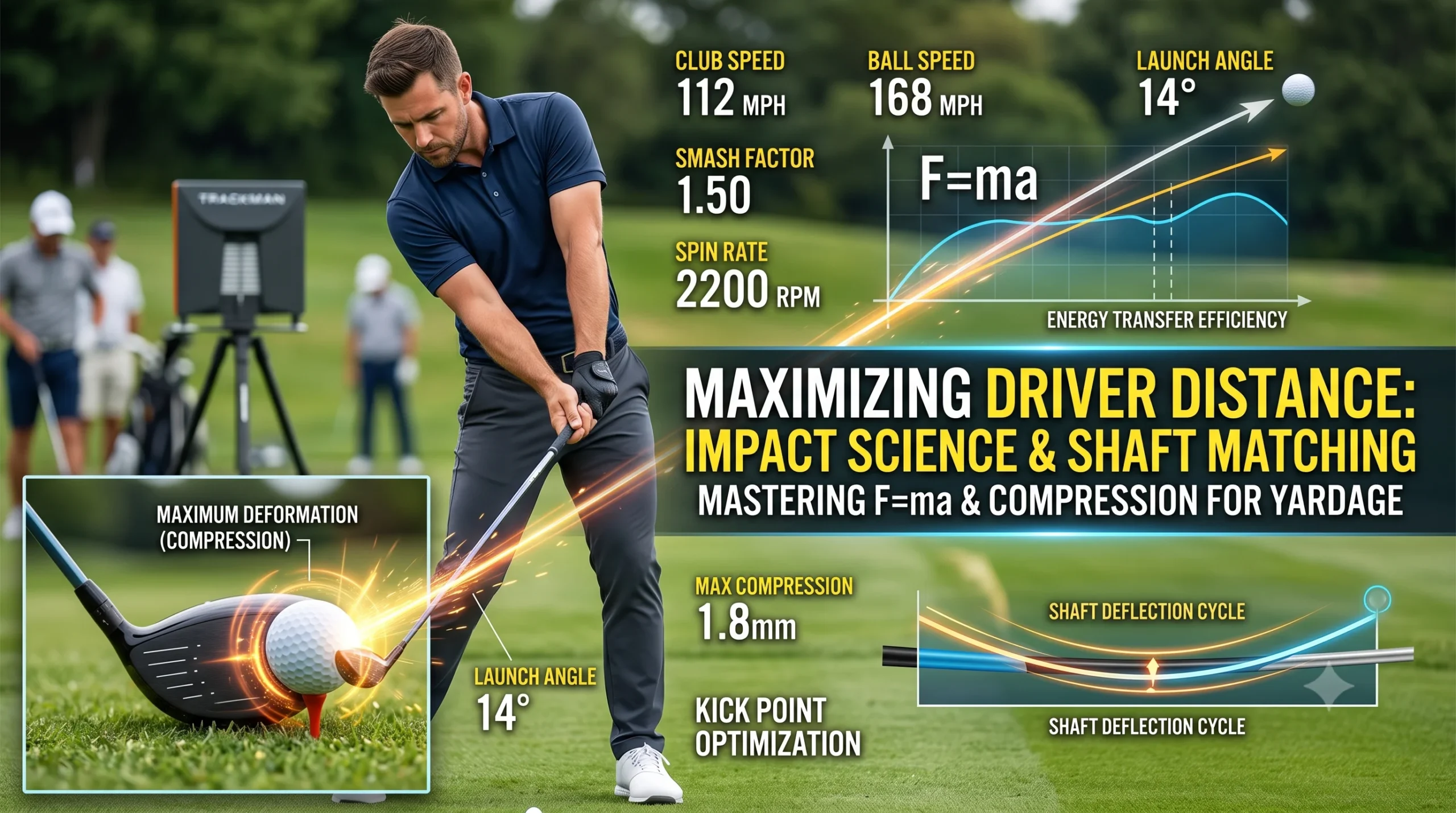
Why are you swinging at 105 mph but still getting outdriven by the player carrying a 95 mph swing speed? You buy the latest $600 carbon-composite driver head, dial in the loft sleeve, and yet your launch monitor reveals high spin rate, sub-optimal ball speed, and lost yardage. The problem is almost never the driver head—it is the energy transfer efficiency at impact and a mismatch in shaft dynamics
The Physics Behind It: Energy Transfer and Ball Compression
The foundation of hit distance comes down to the force equation , but at impact, this manifests as momentum transfer and structural energy store-and-release mechanics over a contact window of roughly 450 microseconds.
Total Distance Deficit = Energy Lost to Thermal/Acoustic Dissipation + Spin-Decay DragWhen a clubhead collides with a golf ball, maximum distance requires optimizing three primary physical variables:
- Impact Compression Ratio: A golf ball behaves as a non-linear viscoelastic spring. If your swing speed is 90 mph and you hit a high-compression ball (e.g., 100+ compression rating), the collision remains partially elastic—meaning the ball fails to deform optimally, resulting in lower coefficient of restitution (COR) and dropped ball speed. Conversely, if a 115 mph swing hits a soft ball, over-deformation leads to hysteresis energy loss (energy lost as heat rather than kinetic thrust).
- Dynamic Deflection and Kick Point: As you transition from the backswing to the downswing, the shaft undergoes dynamic bending. The shaft must “un-load” precisely at impact to present a perpendicular face to the ball with neutral-to-slightly-ascending attack angles. If the shaft flex profile is too soft, the head lags or over-deflects, increasing dynamic loft and adding spin rate over 3,000 RPM—destroying carry distance.
- Smash Factor Efficiency: Smash Factor is defined as:
To hit the theoretical maximum smash factor of 1.50 with a modern driver, the shaft must stabilize the head off-center impacts, minimizing gear effect rotational torque.
Interactive Tool Placeholder
Golf Swing Physics Simulator
F=ma Force, Shaft Stiffness & Distance Visualizer
Step-by-Step Troubleshooting: Optimizing Shaft Profiles and Impact
To translate these physical mechanics into actionable yardage on the course, follow this 3-step shaft optimization protocol:
Step 1: Match Shaft Flex Profile to Swing Speed & Transition Dynamics
Compare your measured swing speed with the optimal shaft torque and frequency (CPM - Cycles Per Minute):
| Swing Speed (mph) | Ball Compression Target | Shaft Flex Recommendation | Shaft Weight (g) | Torque Degree (°) |
|---|---|---|---|---|
| Below 85 | 60 - 70 | Senior / A-Flex | 45g - 50g | > 5.0° |
| 85 - 95 | 70 - 80 | Regular (R) | 50g - 60g | 4.0° - 4.5° |
| 95 - 105 | 85 - 90 | Stiff (S) | 60g - 65g | 3.2° - 3.8° |
| 105 - 115 | 90 - 100 | Extra Stiff (X) | 65g - 75g | 2.5° - 3.2° |
| 115+ | 100+ | Tour Extra Stiff (TX) | 70g+ | < 2.5° |
Note: If you have an aggressive, fast tempo downswing, step up one level in stiffness or decrease torque rating even if your raw swing speed sits on a boundary.
Step 2: Adjust Shaft Tip Stiffness to Control Spin Rates
- High Launch / High Spin Issues: Choose a tip-stiff shaft profile (e.g., Fujikura Ventus Black or Mitsubishi Tensei 1K Black) to lower the dynamic loft and maintain spin between 2,000–2,400 RPM.
- Low Launch / Low Spin Issues: Choose a mid-to-soft tip shaft (e.g., Graph Design Tour AD IZ or Fujikura Ventus Red) to increase launch angle and optimize carry time.
Step 3: Dial in Total Weight to Maximize Centeredness of Contact
- If your impact pattern on the face shows wide dispersion (heel and toe hits), the total club weight or shaft weight is often too light, causing loss of spatial awareness during the downswing.
- Increase shaft weight in 5g increments until strike consistency tightens around the sweet spot. A centered hit with 100 mph swing speed beats an off-center hit with 105 mph swing speed every time due to gear effect energy loss.
Conclusion & CTA
Maximizing your driver distance is not about swinging harder—it is about managing force transfer (), optimizing ball compression, and matching shaft bending profiles to your specific swing kinematics. When your shaft unloads efficiently at impact, ball speed jumps without adding extra physical effort.
For more insights into the physics of sports and gear optimization, dive into [Gear & Logic: Applied Physics and Mathematics], or find more performance calculators in our [Interactive Tools: Live Science & Engineering Calculators] section