
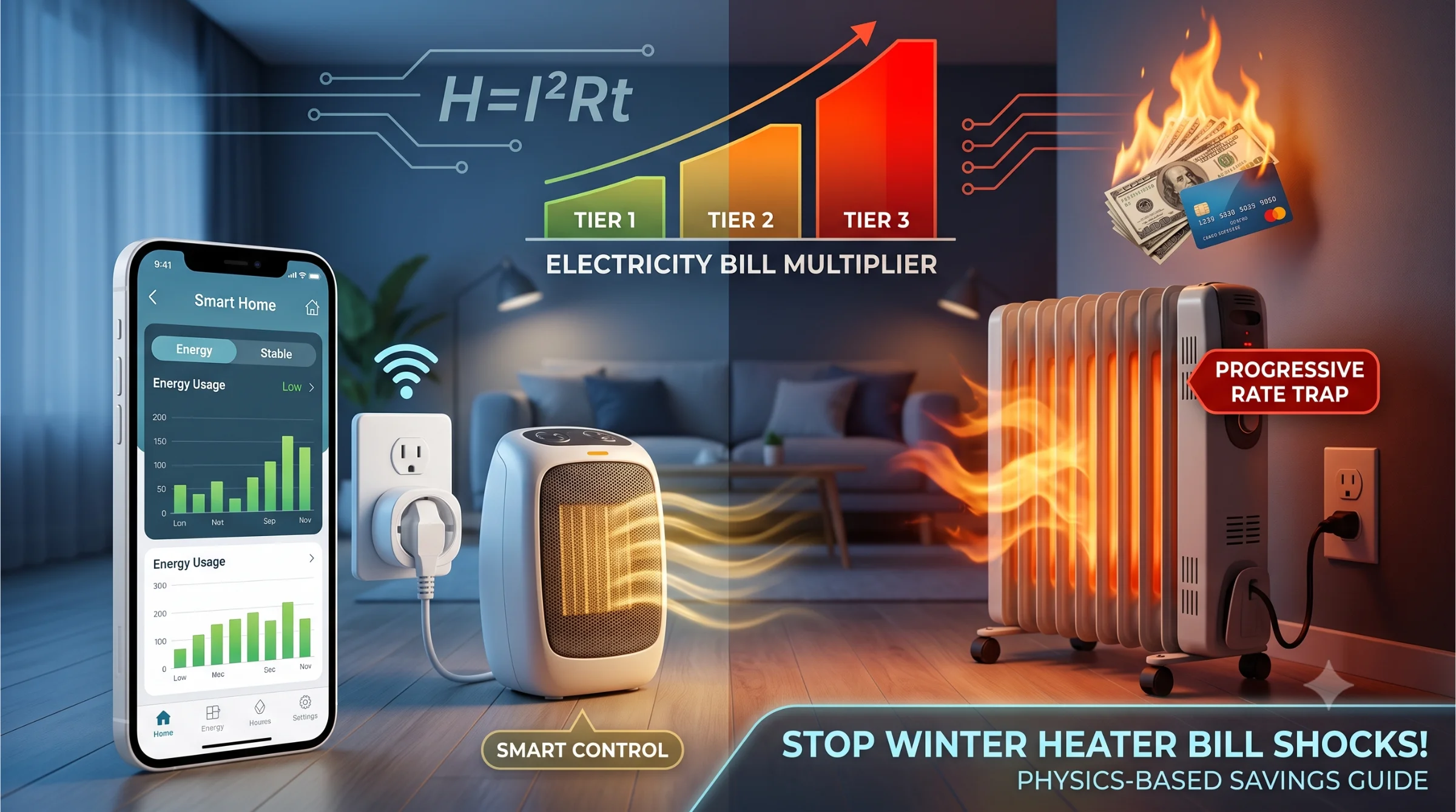
Are you dreading that winter electric bill after plugging in a portable space heater or oil radiator? You leave a 2,000W heater running just to keep a home office warm, only to get hit with a shocker of a bill at the end of the month.
You’re not alone. The problem isn’t just how much power your heater draws—it’s how that power stacks up against progressive electricity pricing. Let’s break down the actual energy physics behind winter heating and how you can outsmart your utility provider without freezing.
The Physics Behind It: How Electricity Turns Into Heat (and Debt)
Every electric resistance heater—whether it’s a ceramic fan heater, an oil-filled radiator, or a halogen lamp—operates on the same fundamental principle: Joule Heating (or resistive heating).
Mathematically, thermal energy produced is represented as:
$$H = I^2 R t$$
Where:
- $H$ = Heat generated (Joules)
- $I$ = Electric current (Amperes)
- $R$ = Resistance of the heating element (Ohms)
- $t$ = Time (Seconds)
Since power ($P$, measured in Watts) equals $I^2 R$, we can simplify this to:
$$\text{Energy consumed (kWh)} = \frac{\text{Power (Watts)} \times \text{Time (Hours)}}{1000}$$
Why Heaters Are “100% Efficient” Yet Brutally Expensive
Electric heaters are technically 100% efficient—every single Watt of electricity drawn converts into heat. However, electricity is an expensive medium for heat production compared to natural gas or heat pumps.
Here is how common winter appliances stack up in power draw and estimated costs:
| Appliance Type | Average Power (W) | Daily Usage (4 Hours) | Estimated Monthly Cost* |
| Lasko Ceramic Heater | 1,500W | 6.0 kWh | High progressive tier impact |
| Oil-Filled Radiator | 1,500W – 2,000W | 6.0 – 8.0 kWh | High progressive tier impact |
| PTC Tower Heater | 1,200W – 2,000W | 4.8 – 8.0 kWh | High progressive tier impact |
| Electric Heating Blanket | 100W – 150W | 0.4 – 0.6 kWh | Negligible |
| Inverter Aircon (Heating) | 600W – 1,000W | 2.4 – 4.0 kWh | Moderate (High COP efficiency) |
*Note: Actual costs depend heavily on your local progressive rate brackets.
The Progressive Rate Trap
The real multiplier on your bill isn’t just the raw kWh—it’s the progressive rate bracket. When a 2,000W heater runs for 6 hours a day, it adds 360 kWh per month to your baseline consumption. This addition pushes your entire household baseline into tier-2 or tier-3 pricing, where the cost per kWh can double or triple.
Interactive Tool Placeholder
Electric Heater Cost Simulator
Visual energy & bill simulation
Step-by-Step Troubleshooting: Defending Your Bill
To enjoy targeted warmth without triggering progressive rate penalties, implement this 3-step energy management strategy:
Step 1: Deploy a Smart Plug with Power Monitoring
Don’t guess your energy usage—measure it.
- Auto-Off Automation: Program smart plugs to shut off automatically after 45 or 60 minutes.
- Overconsumption Alerts: Set up routines to cut power if daily cumulative usage exceeds a set limit (e.g., 3 kWh).
- Schedule Optimization: Run heaters only 10 minutes prior to room entry rather than leaving them on continuously.
Step 2: Leverage Thermal Inertia and Micro-Heating
Instead of trying to heat the ambient air volume of an entire room:
- Micro-Heating: Switch to electric blankets or heated desk mats (100W vs. 1,500W). This delivers heat directly to your body via conduction rather than convection, cutting power consumption by up to 93%.
- Thermal Inertia: If using an oil radiator, turn it off 30 minutes before leaving the room. The retained thermal mass of the oil continues radiating heat without drawing electricity.
Step 3: Upgrade to Inverter Heat Pump Systems
If you require long-duration space heating, resistive heating ($H=I^2Rt$) is inherently disadvantaged.
- COP (Coefficient of Performance): Resistive heaters have a COP of 1.0 (1kW in = 1kW heat out). Modern heat pump air conditioners have a COP of 3.0 to 4.0, delivering 3 to 4 times more heat energy for the exact same electricity input by moving ambient heat rather than generating it from scratch.
Smart Thermal Optimization Summary
Electric heaters aren’t inherently bad; they are simply specialized, high-load tools. By controlling operational duration ($t$) via smart plugs and supplementing local ambient heating with low-wattage direct heating, you isolate your power consumption safely below progressive tier thresholds.
Learn more about the electric and thermal forces dictating home appliance efficiency in [Gear & Logic: Applied Physics and Mathematics], or plan your utility budget in [Interactive Tools: Live Science & Engineering Calculators].