
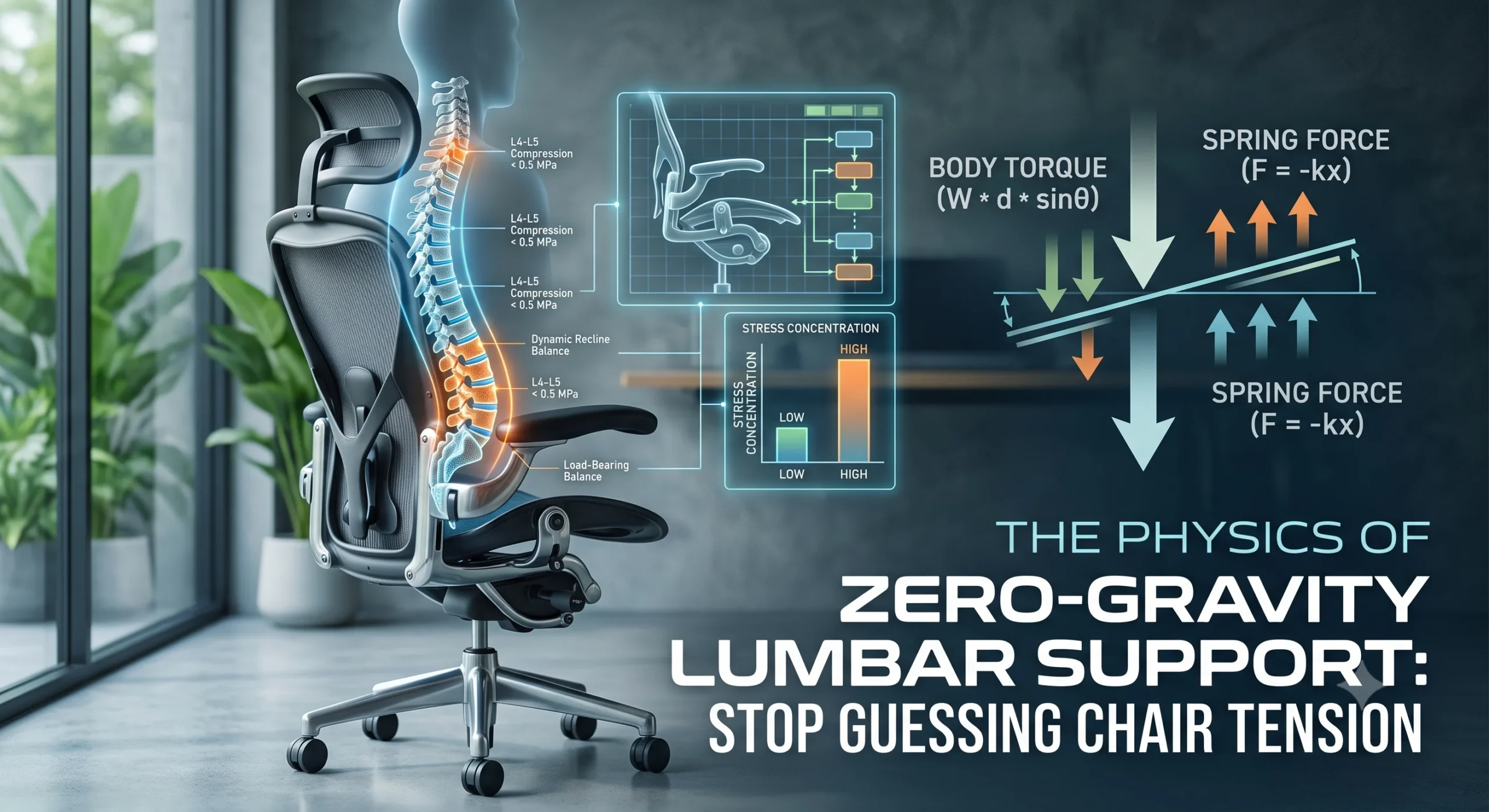
Why does your $1,500 Herman Miller or Steelcase still leave your lower back throbbing after four hours of deep work? You bought top-tier ergonomics, set the seat height according to the manual, yet your L4-L5 vertebrae feel like they are trapped in a hydraulic press. The problem isn’t the chair; it’s your blind calibration of its mechanical resistance.
The Physics Behind It: Elastic Limits and Spinal Load Distribution
When you lean back in an office chair, your body weight converts potential energy into mechanical torque applied directly to the recline spring mechanism. Most users treat tension adjustment as a preference rather than a structural load balance problem.
Spinal Load Physics Equation
- Static Recline Torque: $T = W \cdot d \cdot \sin(\theta)$
- Spring Reaction Force: $F = -k \cdot x$
Where $W$ is upper body weight (~60% of total mass), $d$ is distance from pivot to center of gravity, $\theta$ is recline angle, $k$ is spring constant, and $x$ is spring displacement.
The Hooke’s Law Trap and Spring Creep
Standard lumbar support relies on spring deformation to exert force against the lumbar spine ($F = -k x$). However, two physical phenomena break down ergonomic efficiency during prolonged sitting:
- Elastic Limit Threshold ($R_e$): Over-tightening the tilt mechanism forces the internal spring near its yield point, converting smooth mechanical resistance into rigid static pressure. This concentrates the entire force directly onto the L5-S1 disc instead of dynamic dispersion.
- Viscoelastic Creep: Human soft tissue exhibits time-dependent deformation under continuous force. If your chair’s spring constant ($k$) is dialed too soft, your lumbar curve slowly flattens into hyper-flexion over an eight-hour shift, increasing intervertebral disc pressure by up to 180%.
To keep intra-discal pressure below 0.5 MPa (the threshold for structural fatigue), the mechanical resistance of the recline spring must perfectly mirror the weight vector of your upper torso across a recline envelope of 100° to 115°.
Interactive Tool Placeholder
Tilt Tension Calculator
Find your ergonomic balance based on weight
Step-by-Step Troubleshooting: The Self-Fitting Tension Protocol
Forget the trial-and-error approach. Follow this engineering-backed calibration protocol to achieve equilibrium between your body weight and the chair’s spring mechanism.
Step 1: Establish the Zero-Load Baseline
Completely disengage the tilt lock and back off the tension knob counter-clockwise until the recline mechanism moves freely without resistance. Sit flush against the mesh or foam backrest with your feet flat on the floor.
Step 2: Calibrate Tension for Dynamic Equilibrium
Lean back to a 105-degree angle (the biomechanical sweet spot for reducing disc pressure). Adjust the tension knob clockwise until you achieve float—a state where the chair supports your upper body without requiring core muscular engagement to stay back or leg force to push forward.
Step 3: Match Weight Class to Resistance Profiles
Use the reference matrix below to fine-tune your chair’s tilt mechanism based on body mass and spring resistance profile:
| Weight Category | Body Mass (kg / lbs) | Recommended Recline Angle | Spring Resistance Profile ($k$-Value) | Knob Calibration Turns (from Min) |
|---|---|---|---|---|
| Lightweight | $< 60 \text{ kg} / < 132 \text{ lbs}$ | $100^\circ – 105^\circ$ | Soft ($k \approx 15-20 \text{ N/mm}$) | $2 – 4$ full turns |
| Medium | $60 – 85 \text{ kg} / 132 – 187 \text{ lbs}$ | $105^\circ – 110^\circ$ | Medium ($k \approx 20-30 \text{ N/mm}$) | $5 – 8$ full turns |
| Heavyweight | $> 85 \text{ kg} / > 187 \text{ lbs}$ | $110^\circ – 115^\circ$ | Firm ($k \approx 30-40+ \text{ N/mm}$) | $9 – 12+$ full turns |
Conclusion & Ergonomic Recommendation
Achieving true zero-gravity comfort on high-end office seating is an exercise in structural mechanics, not subjective comfort. By balancing your body’s gravitational torque against the spring’s elastic coefficient, you eliminate static disc compression and tissue creep. Re-calibrate your tilt mechanism whenever your footwear or desk height changes to maintain optimal spinal equilibrium.
Discover more science-backed lifestyle design tips in our [Gear & Logic: Applied Physics and Mathematics] directory, and don’t forget to explore other practical simulators in [Interactive Tools: Live Science & Engineering CalculatorsInteractive Tools: Live Science & Engineering Calculators].